Filters
Question type

Study Flashcards

Table 3-26 Assume that Japan and Korea can switch between producing cars and producing airplanes at a constant rate. ​ Table 3-26 Assume that Japan and Korea can switch between producing cars and producing airplanes at a constant rate. ​   -Refer to Table 3-26. Japan's opportunity cost of one car is A) 1/5 airplane and Korea's opportunity cost of one car is 1/3 airplane. B) 1/5 airplane and Korea's opportunity cost of one car is 3 airplanes. C) 5 airplanes and Korea's opportunity cost of one car is 1/3 airplane. D) 5 airplanes and Korea's opportunity cost of one car is 3 airplanes. -Refer to Table 3-26. Japan's opportunity cost of one car is


A) 1/5 airplane and Korea's opportunity cost of one car is 1/3 airplane.
B) 1/5 airplane and Korea's opportunity cost of one car is 3 airplanes.
C) 5 airplanes and Korea's opportunity cost of one car is 1/3 airplane.
D) 5 airplanes and Korea's opportunity cost of one car is 3 airplanes.

E) B) and D)
F) All of the above

Correct Answer

verifed

verified

Table 3-21 Assume that Jamaica and Norway can switch between producing coolers and producing radios at a constant rate. The following table shows the number of coolers or number of radios each country can produce in one day. Table 3-21 Assume that Jamaica and Norway can switch between producing coolers and producing radios at a constant rate. The following table shows the number of coolers or number of radios each country can produce in one day.   -Refer to Table 3-21. Jamaica should specialize in the production of A) coolers and Norway should specialize in the production of radios. B) radios and Norway should specialize in the production of coolers. C) both goods and Norway should specialize in the production of neither good. D) neither good and Norway should specialize in the production of both goods. -Refer to Table 3-21. Jamaica should specialize in the production of


A) coolers and Norway should specialize in the production of radios.
B) radios and Norway should specialize in the production of coolers.
C) both goods and Norway should specialize in the production of neither good.
D) neither good and Norway should specialize in the production of both goods.

E) C) and D)
F) A) and D)

Correct Answer

verifed

verified

Table 3-16 The following table contains some production possibilities for an economy for a given month. Table 3-16 The following table contains some production possibilities for an economy for a given month.   -Refer to Table 3-16. If the production possibilities frontier is bowed outward, then  ?  could be A) 200. B) 300. C) 400. D) 500. -Refer to Table 3-16. If the production possibilities frontier is bowed outward, then "?" could be


A) 200.
B) 300.
C) 400.
D) 500.

E) C) and D)
F) None of the above

Correct Answer

verifed

verified

The principle of comparative advantage does not provide answers to certain questions. One of those questions is


A) Do specialization and trade benefit more than one party to a trade?
B) Is it absolute advantage or comparative advantage that really matters?
C) How are the gains from trade shared among the parties to a trade?
D) Is it possible for specialization and trade to increase total output of traded goods?

E) A) and B)
F) A) and C)

Correct Answer

verifed

verified

Table 3-41 ​ ​ Table 3-41 ​ ​   -Refer to Table 3-41. If the two countries specialize and trade with each other, which country will import compasses? -Refer to Table 3-41. If the two countries specialize and trade with each other, which country will import compasses?

Correct Answer

verifed

verified

Specialization and trade are closely linked to


A) absolute advantage.
B) comparative advantage.
C) gains to some traders that exactly offset losses to other traders.
D) shrinkage of the economic pie.

E) A) and D)
F) B) and C)

Correct Answer

verifed

verified

Table 3-31 ​ Table 3-31 ​   -Refer to Table 3-31. For the farmer, the opportunity cost of 1 pound of meat is A) 0.625 pound of potatoes. B) 1.6 pounds of potatoes. C) 5 pounds of potatoes. D) 8 pounds of potatoes. -Refer to Table 3-31. For the farmer, the opportunity cost of 1 pound of meat is


A) 0.625 pound of potatoes.
B) 1.6 pounds of potatoes.
C) 5 pounds of potatoes.
D) 8 pounds of potatoes.

E) A) and B)
F) None of the above

Correct Answer

verifed

verified

Figure 3-18 Bintu's Production Possibilities Frontier Juba's Production Possibilities Frontier Figure 3-18 Bintu's Production Possibilities Frontier Juba's Production Possibilities Frontier     -Refer to Figure 3-18. Suppose Juba is willing to trade one bowl to Bintu for every two cups that Bintu makes and sends to Juba. Which of the following combinations of bowls and cups could Bintu then consume, assuming Bintu specializes in making cups and Juba specializes in making bowls? A) 1 bowl and 7 cups B) 2 bowls and 4 cups C) 3 bowls and 3 cups D) 4 bowls and 1 cup Figure 3-18 Bintu's Production Possibilities Frontier Juba's Production Possibilities Frontier     -Refer to Figure 3-18. Suppose Juba is willing to trade one bowl to Bintu for every two cups that Bintu makes and sends to Juba. Which of the following combinations of bowls and cups could Bintu then consume, assuming Bintu specializes in making cups and Juba specializes in making bowls? A) 1 bowl and 7 cups B) 2 bowls and 4 cups C) 3 bowls and 3 cups D) 4 bowls and 1 cup -Refer to Figure 3-18. Suppose Juba is willing to trade one bowl to Bintu for every two cups that Bintu makes and sends to Juba. Which of the following combinations of bowls and cups could Bintu then consume, assuming Bintu specializes in making cups and Juba specializes in making bowls?


A) 1 bowl and 7 cups
B) 2 bowls and 4 cups
C) 3 bowls and 3 cups
D) 4 bowls and 1 cup

E) All of the above
F) A) and B)

Correct Answer

verifed

verified

Figure 3-22 Alice and Betty's Production Possibilities in one 8-hour day. Alice's Production Possibilities Frontier Betty's Production Possibilities Frontier Figure 3-22 Alice and Betty's Production Possibilities in one 8-hour day. Alice's Production Possibilities Frontier Betty's Production Possibilities Frontier     -Refer to Figure 3-22. Which of the following statements is correct regarding comparative advantage? A) Alice has a comparative advantage in the production of both lemonade and pizzas. B) Betty has a comparative advantage in the production of both lemonade and pizzas. C) Alice has a comparative advantage in the production of pizzas while Betty has a comparative advantage in the production of lemonade. D) Alice has a comparative advantage in the production of lemonade while Betty has a comparative advantage in the production of pizzas. Figure 3-22 Alice and Betty's Production Possibilities in one 8-hour day. Alice's Production Possibilities Frontier Betty's Production Possibilities Frontier     -Refer to Figure 3-22. Which of the following statements is correct regarding comparative advantage? A) Alice has a comparative advantage in the production of both lemonade and pizzas. B) Betty has a comparative advantage in the production of both lemonade and pizzas. C) Alice has a comparative advantage in the production of pizzas while Betty has a comparative advantage in the production of lemonade. D) Alice has a comparative advantage in the production of lemonade while Betty has a comparative advantage in the production of pizzas. -Refer to Figure 3-22. Which of the following statements is correct regarding comparative advantage?


A) Alice has a comparative advantage in the production of both lemonade and pizzas.
B) Betty has a comparative advantage in the production of both lemonade and pizzas.
C) Alice has a comparative advantage in the production of pizzas while Betty has a comparative advantage in the production of lemonade.
D) Alice has a comparative advantage in the production of lemonade while Betty has a comparative advantage in the production of pizzas.

E) All of the above
F) B) and C)

Correct Answer

verifed

verified

Table 3-36 Table 3-36   -Refer to Table 3-36. Antigua has an absolute advantage in the production of A) towels and Barbuda has an absolute advantage in the production of umbrellas. B) umbrellas and Barbuda has an absolute advantage in the production of towels. C) both goods and Barbuda has an absolute advantage in the production of neither good. D) neither good and Barbuda has an absolute advantage in the production of both goods. -Refer to Table 3-36. Antigua has an absolute advantage in the production of


A) towels and Barbuda has an absolute advantage in the production of umbrellas.
B) umbrellas and Barbuda has an absolute advantage in the production of towels.
C) both goods and Barbuda has an absolute advantage in the production of neither good.
D) neither good and Barbuda has an absolute advantage in the production of both goods.

E) A) and B)
F) None of the above

Correct Answer

verifed

verified

Figure 3-6 Maxine's Production Possibilities Frontier Daisy's Production Possibilities Frontier Figure 3-6 Maxine's Production Possibilities Frontier Daisy's Production Possibilities Frontier     -Refer to Figure 3-6. If Maxine and Daisy each divides her time equally between making pies and making tarts, then total production is A) 6 pies and 10 tarts. B) 7.5 pies and 3 tarts. C) 7.5 pies and 10 tarts. D) 13.5 pies and 13 tarts. Figure 3-6 Maxine's Production Possibilities Frontier Daisy's Production Possibilities Frontier     -Refer to Figure 3-6. If Maxine and Daisy each divides her time equally between making pies and making tarts, then total production is A) 6 pies and 10 tarts. B) 7.5 pies and 3 tarts. C) 7.5 pies and 10 tarts. D) 13.5 pies and 13 tarts. -Refer to Figure 3-6. If Maxine and Daisy each divides her time equally between making pies and making tarts, then total production is


A) 6 pies and 10 tarts.
B) 7.5 pies and 3 tarts.
C) 7.5 pies and 10 tarts.
D) 13.5 pies and 13 tarts.

E) A) and B)
F) None of the above

Correct Answer

verifed

verified

Figure 3-2 Brazil's Production Possibilities Frontier Figure 3-2 Brazil's Production Possibilities Frontier   -Refer to Figure 3-2. If the production possibilities frontier shown is for two months of production, then which of the following combinations of peanuts and cashews could Brazil not produce in two months? A) 5 peanuts and 88 cashews B) 4 peanuts and 115 cashews C) 3 peanuts and 155 cashews D) 1 peanuts and 200 cashews -Refer to Figure 3-2. If the production possibilities frontier shown is for two months of production, then which of the following combinations of peanuts and cashews could Brazil not produce in two months?


A) 5 peanuts and 88 cashews
B) 4 peanuts and 115 cashews
C) 3 peanuts and 155 cashews
D) 1 peanuts and 200 cashews

E) All of the above
F) A) and C)

Correct Answer

verifed

verified

Table 3-37 Table 3-37   ​ -​Refer to Table 3-37. Sarah and Charles are both potters and each can switch between the production of vases and mugs at a constant rate. The table shows the total number of vases or decorative mugs that each person can produce in a six-hour session of producing pottery. Sarah's opportunity cost to produce one vase is A) ​0.25 mugs and Charles's opportunity cost of producing one vase is 2.5 mugs B) ​4 mugs and Charles's opportunity cost of producing one vase is 2.5 mugs C) ​0.25 mugs and Charles's opportunity cost of producing one vase is 0.40 mugs D) ​4 mugs and Charles's opportunity cost of producing one vase is 0.40 mugs ​ -​Refer to Table 3-37. Sarah and Charles are both potters and each can switch between the production of vases and mugs at a constant rate. The table shows the total number of vases or decorative mugs that each person can produce in a six-hour session of producing pottery. Sarah's opportunity cost to produce one vase is


A) ​0.25 mugs and Charles's opportunity cost of producing one vase is 2.5 mugs
B) ​4 mugs and Charles's opportunity cost of producing one vase is 2.5 mugs
C) ​0.25 mugs and Charles's opportunity cost of producing one vase is 0.40 mugs
D) ​4 mugs and Charles's opportunity cost of producing one vase is 0.40 mugs

E) A) and B)
F) A) and C)

Correct Answer

verifed

verified

International trade may make some individuals in a nation better off, while other individuals are made worse off.

A) True
B) False

Correct Answer

verifed

verified

Table 3-30 Assume that Falda and Varick can switch between producing wheat and producing cloth at a constant rate. Table 3-30 Assume that Falda and Varick can switch between producing wheat and producing cloth at a constant rate.   -Refer to Table 3-30. Varick has an absolute advantage in the production of A) wheat. B) cloth. C) both goods. D) neither good. -Refer to Table 3-30. Varick has an absolute advantage in the production of


A) wheat.
B) cloth.
C) both goods.
D) neither good.

E) B) and C)
F) All of the above

Correct Answer

verifed

verified

Figure 3-17 Maxine's Production Possibilities Frontier Daisy's Production Possibilities Frontier Figure 3-17 Maxine's Production Possibilities Frontier Daisy's Production Possibilities Frontier     -Refer to Figure 3-17. Maxine has an absolute advantage in the production of A) both goods and a comparative advantage in the production of pies. B) both goods and a comparative advantage in the production of tarts. C) neither good and a comparative advantage in the production of pies. D) neither good and a comparative advantage in the production of tarts. Figure 3-17 Maxine's Production Possibilities Frontier Daisy's Production Possibilities Frontier     -Refer to Figure 3-17. Maxine has an absolute advantage in the production of A) both goods and a comparative advantage in the production of pies. B) both goods and a comparative advantage in the production of tarts. C) neither good and a comparative advantage in the production of pies. D) neither good and a comparative advantage in the production of tarts. -Refer to Figure 3-17. Maxine has an absolute advantage in the production of


A) both goods and a comparative advantage in the production of pies.
B) both goods and a comparative advantage in the production of tarts.
C) neither good and a comparative advantage in the production of pies.
D) neither good and a comparative advantage in the production of tarts.

E) All of the above
F) A) and C)

Correct Answer

verifed

verified

Figure 3-19 Chile's Production Possibilities Frontier Colombia's Production Possibilities Frontier Figure 3-19 Chile's Production Possibilities Frontier Colombia's Production Possibilities Frontier     -Refer to Figure 3-19. If Chile and Colombia each spends all of its time producing the good in which it has a comparative advantage and the countries agree to trade 7 pounds of coffee for 5 pounds of soybeans, then Chile will consume A) 7 pounds of coffee and 7 pounds of soybeans and Colombia will consume 5 pounds of coffee and 5 pounds of soybeans. B) 7 pounds of coffee and 7 pounds of soybeans and Colombia will consume 5 pounds of coffee and 11 pounds of soybeans. C) 23 pounds of coffee and 7 pounds of soybeans and Colombia will consume 5 pounds of coffee and 5 pounds of soybeans. D) 23 pounds of coffee and 7 pounds of soybeans and Colombia will consume 5 pounds of coffee and 11 pounds of soybeans. Figure 3-19 Chile's Production Possibilities Frontier Colombia's Production Possibilities Frontier     -Refer to Figure 3-19. If Chile and Colombia each spends all of its time producing the good in which it has a comparative advantage and the countries agree to trade 7 pounds of coffee for 5 pounds of soybeans, then Chile will consume A) 7 pounds of coffee and 7 pounds of soybeans and Colombia will consume 5 pounds of coffee and 5 pounds of soybeans. B) 7 pounds of coffee and 7 pounds of soybeans and Colombia will consume 5 pounds of coffee and 11 pounds of soybeans. C) 23 pounds of coffee and 7 pounds of soybeans and Colombia will consume 5 pounds of coffee and 5 pounds of soybeans. D) 23 pounds of coffee and 7 pounds of soybeans and Colombia will consume 5 pounds of coffee and 11 pounds of soybeans. -Refer to Figure 3-19. If Chile and Colombia each spends all of its time producing the good in which it has a comparative advantage and the countries agree to trade 7 pounds of coffee for 5 pounds of soybeans, then Chile will consume


A) 7 pounds of coffee and 7 pounds of soybeans and Colombia will consume 5 pounds of coffee and 5 pounds of soybeans.
B) 7 pounds of coffee and 7 pounds of soybeans and Colombia will consume 5 pounds of coffee and 11 pounds of soybeans.
C) 23 pounds of coffee and 7 pounds of soybeans and Colombia will consume 5 pounds of coffee and 5 pounds of soybeans.
D) 23 pounds of coffee and 7 pounds of soybeans and Colombia will consume 5 pounds of coffee and 11 pounds of soybeans.

E) B) and C)
F) C) and D)

Correct Answer

verifed

verified

Figure 3-8 Chile's Production Possibilities Frontier Colombia's Production Possibilities Frontier Figure 3-8 Chile's Production Possibilities Frontier Colombia's Production Possibilities Frontier     -Refer to Figure 3-8. If the production possibilities frontiers shown are each for one day of production, then which of the following combinations of coffee and soybeans could Chile and Colombia together make in a given day? A) 4 pounds of coffee and 16 pounds of soybeans B) 8 pounds of coffee and 15 pounds of soybeans C) 16 pounds of coffee and 10 pounds of soybeans D) 24 pounds of coffee and 4 pounds of soybeans Figure 3-8 Chile's Production Possibilities Frontier Colombia's Production Possibilities Frontier     -Refer to Figure 3-8. If the production possibilities frontiers shown are each for one day of production, then which of the following combinations of coffee and soybeans could Chile and Colombia together make in a given day? A) 4 pounds of coffee and 16 pounds of soybeans B) 8 pounds of coffee and 15 pounds of soybeans C) 16 pounds of coffee and 10 pounds of soybeans D) 24 pounds of coffee and 4 pounds of soybeans -Refer to Figure 3-8. If the production possibilities frontiers shown are each for one day of production, then which of the following combinations of coffee and soybeans could Chile and Colombia together make in a given day?


A) 4 pounds of coffee and 16 pounds of soybeans
B) 8 pounds of coffee and 15 pounds of soybeans
C) 16 pounds of coffee and 10 pounds of soybeans
D) 24 pounds of coffee and 4 pounds of soybeans

E) A) and B)
F) B) and C)

Correct Answer

verifed

verified

When can two countries gain from trading two goods?


A) when the first country can only produce the first good and the second country can only produce the second good
B) when the first country can produce both goods, but can only produce the second good at great cost, and the second country can produce both goods, but can only produce the first good at great cost
C) when the first country is better at producing both goods and the second country is worse at producing both goods
D) Two countries could gain from trading two goods under all of the above conditions.

E) None of the above
F) B) and C)

Correct Answer

verifed

verified

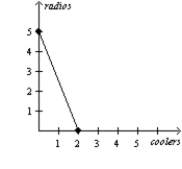
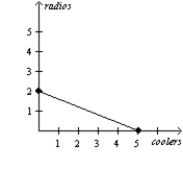
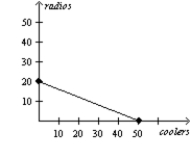
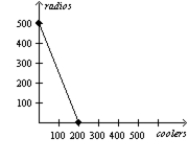
Table 3-5 Assume that Aruba and Iceland can switch between producing coolers and producing radios at a constant rate. Table 3-5 Assume that Aruba and Iceland can switch between producing coolers and producing radios at a constant rate.   -Refer to Table 3-5. Which of the following represents Aruba's production possibilities frontier when 100 labor hours are available? A)    B)    C)    D)   -Refer to Table 3-5. Which of the following represents Aruba's production possibilities frontier when 100 labor hours are available?


A) Table 3-5 Assume that Aruba and Iceland can switch between producing coolers and producing radios at a constant rate.   -Refer to Table 3-5. Which of the following represents Aruba's production possibilities frontier when 100 labor hours are available? A)    B)    C)    D)
B) Table 3-5 Assume that Aruba and Iceland can switch between producing coolers and producing radios at a constant rate.   -Refer to Table 3-5. Which of the following represents Aruba's production possibilities frontier when 100 labor hours are available? A)    B)    C)    D)
C) Table 3-5 Assume that Aruba and Iceland can switch between producing coolers and producing radios at a constant rate.   -Refer to Table 3-5. Which of the following represents Aruba's production possibilities frontier when 100 labor hours are available? A)    B)    C)    D)
D) Table 3-5 Assume that Aruba and Iceland can switch between producing coolers and producing radios at a constant rate.   -Refer to Table 3-5. Which of the following represents Aruba's production possibilities frontier when 100 labor hours are available? A)    B)    C)    D)

E) A) and B)
F) All of the above

Correct Answer

verifed

verified

Showing 301 - 320 of 550

Related Exams

Show Answer